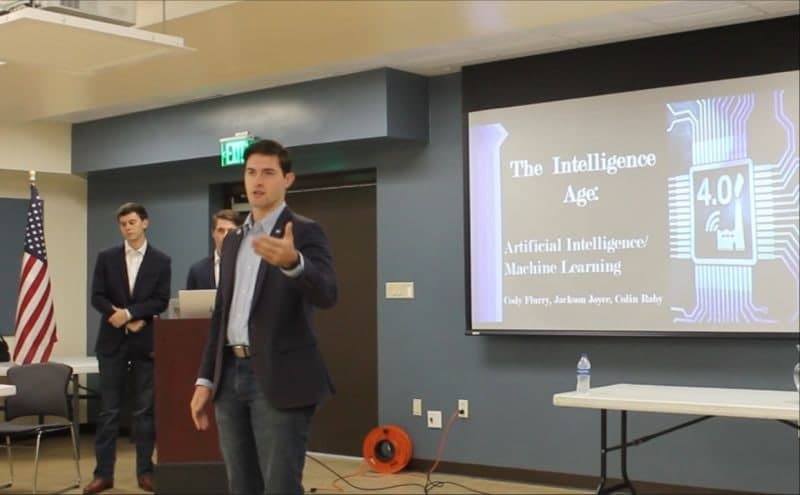
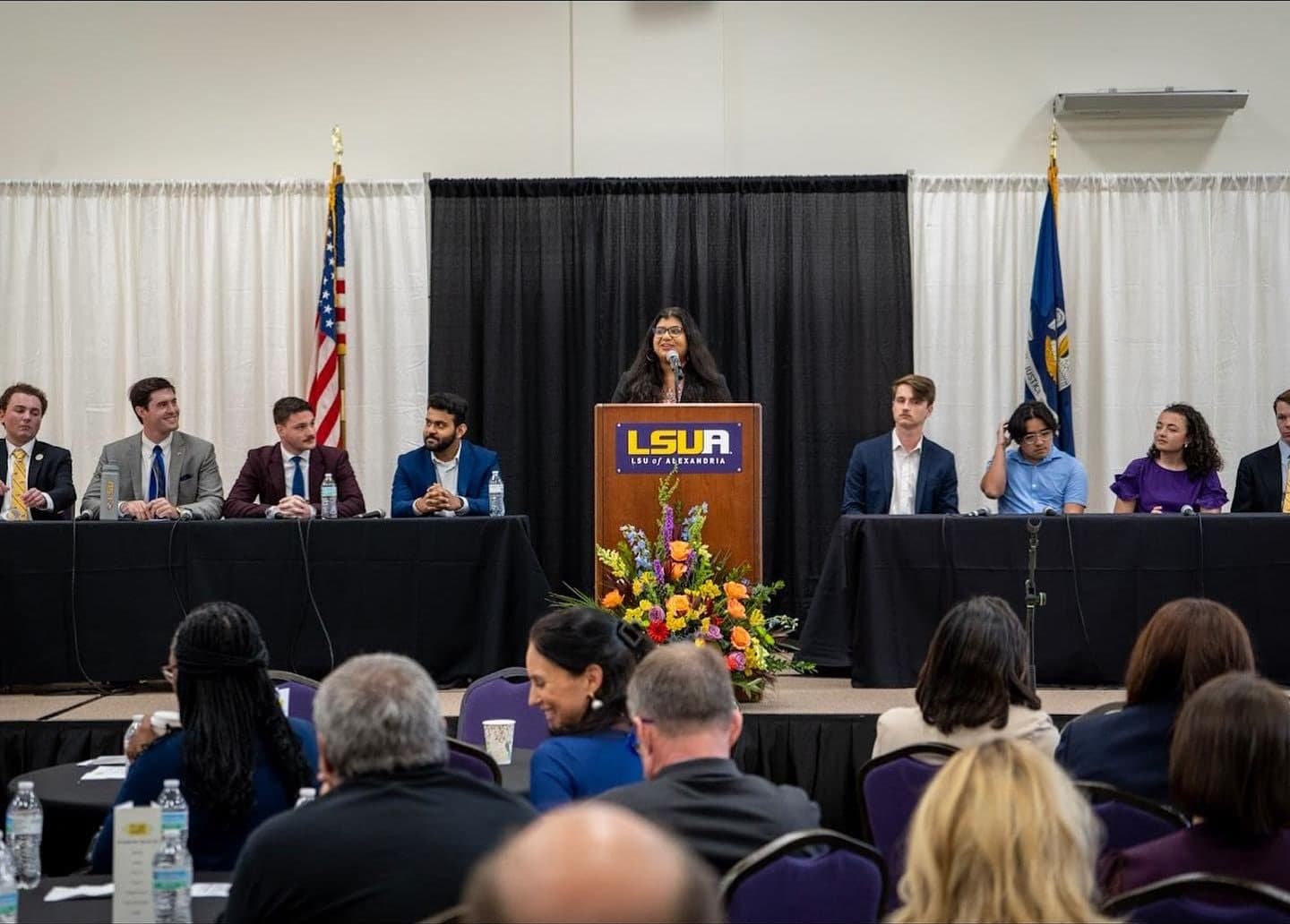
Presents “Education in the Intelligence Age” at University Laboratory School's STEAM Day
At University Laboratory School's STEAM Day, Raby gives families a guide to the Intelligence Age: what AI is, how to use it well, and why schools should teach it instead of banning it.
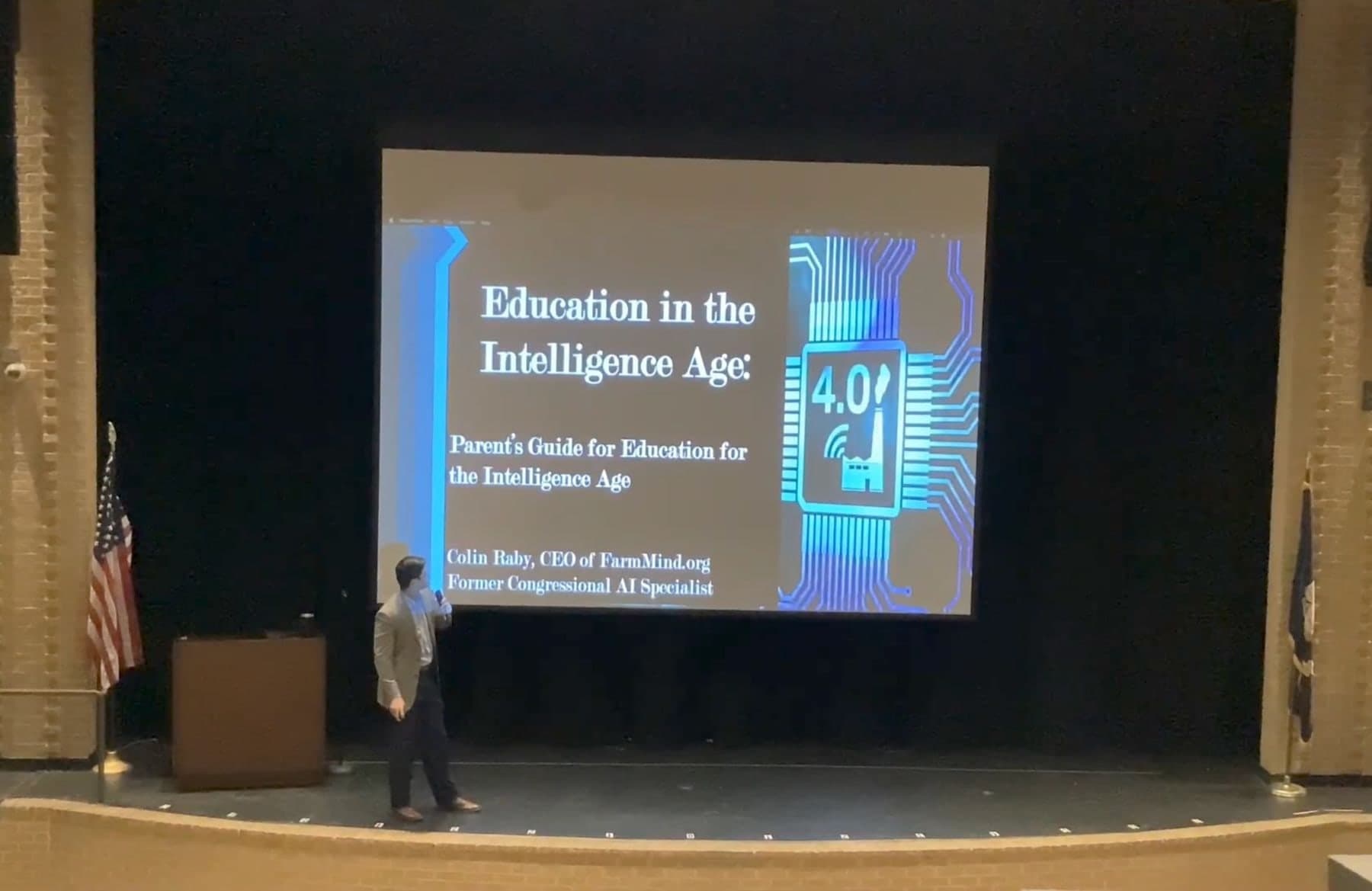
BATON ROUGE, La. · Raby presented "Education in the Intelligence Age," a parent's guide to education for the era of AI, at STEAM Day at University Laboratory School, LSU's lab school and Louisiana's first STEM-accredited school.
He began with the history of disruption. Each industrial revolution has changed what power is and how widely it is held: the first unlocked raw power with heavy machinery; the second distributed it through the electric grid and electronics; the third, the Information Age, turned it into information through the internet and personal devices. The fourth, which Raby calls the Intelligence Age, turns that widely available information into intelligence, produced on demand. He set it against one of the oldest ambitions in computing, Steve Jobs's vision of a personal tutor for every student, and argued that for the first time it is within reach.Raby first made the case for the Intelligence Age in a 2023 letter in The Reveille, then in talks to community advisory panels across Louisiana. On AI as “the equivalent of the world’s best professor or tutor on demand,” see “Adapting Educational Institutions for the Intelligence Age” (Substack, Dec. 2024).
From there, he gave families a working understanding of the technology. Large language models are pattern-recognition machines: they predict the most likely next word from patterns learned across human language. That makes them powerful and fallible. They can be random, they can hallucinate, and public models are not private. His rules follow from that: check the logic as well as the answer, and never put personal or sensitive information into a public model.
On the classroom, his position was direct: teach AI rather than ban it, because the students who master today's tools are the ones who will shape what comes next. Used well, AI is an always-on personal tutor, patient and individual, whether the subject is spelling, algebra or physics.“Rejecting AI tools out of fear or misunderstanding is a mistake”: “Adapting Educational Institutions,” §5. On tutors that “do not tire” and are “endlessly patient,” see “What the ‘Mississippi Miracle’ Foreshadows for Education in the Intelligence Age” (Substack, June 2025), Principle #3. Used badly, it becomes a crutch. He warned against copy-and-paste and urged students to read, question and rewrite what an AI gives them, so the learning stays theirs.
For schools themselves, Raby's argument is that the classroom has barely changed in a century. It still rewards students for predicting which questions will be asked and reproducing the expected answers, which are exactly the skills machines now do best.“The current educational system primarily rewards students for playing a guessing game”: “Adapting Educational Institutions,” Intro. His prescription, developed in his essays "Adapting Educational Institutions for the Intelligence Age" and "What the 'Mississippi Miracle' Foreshadows for Education in the Intelligence Age", comes down to six shifts:
- Reward better questions. When AI can answer most questions, the human edge is deciding what to ask and why. Schools should reward thinking from fundamental principles, and give credit to a student who improves a question, not just one who answers it.“In the Intelligence Age, asking the best question is more valuable than simply providing the correct answer”: “Adapting Educational Institutions,” §2.
- Double down on experiential learning. Labs, industry partnerships and real-world projects teach what AI cannot replicate.“AI cannot easily replace valuable experiential learning opportunities”: “Adapting Educational Institutions,” §3.
- Teach evaluation, not just production. When AI can do the first 90% of an essay, a model or an analysis, the skill that matters is judging that work and making it better.The Intelligence Age “will shift the focus of education from the initial generation of content to the evaluation and refinement of AI-generated content”: “Adapting Educational Institutions,” §4.
- Advance on mastery, not seat time. Mississippi's literacy turnaround came from promoting students when they could read rather than when they reached an age, backed by universal screening, real-time data driving intervention, and trained literacy coaches working alongside teachers in the lowest-performing schools. "What Mississippi paid $100 per student per year to do," Raby writes, "AI can now scale to global levels at a fraction of that cost."“Age is a lousy proxy for readiness; Mississippi finally admitted it”: “The Mississippi Miracle,” Principle #1. The $100 figure is from Principle #3.
- Bring the tools in and give the time back. Embed AI tutors in daily lessons with teachers in control, then reinvest the time they save in small-group coaching, hands-on projects and human-to-human learning.Track the “time dividend” and “reinvest it in human-to-human learning, experiential learning, and skill-building”: “The Mississippi Miracle,” Blueprint for Institutions.
- End the stigma. Treat AI as a tool to master, not a form of cheating: "To banish a tool for its misuse is to surrender the power it offers to improve the world."“Adapting Educational Institutions,” §6, written after finding that young professionals in an office treated having ChatGPT open on screen as cheating.
The stakes, as he frames them, are institutional and national: schools that resist will be overtaken the way Netflix overtook Blockbuster, and for the country, "if we fail to teach our youth to command the tools of tomorrow, we shall find ourselves commanded by those who do."“Adapting Educational Institutions,” Intro (Netflix and Blockbuster) and §7, “A Matter of Global Competitiveness.” "AI cannot replace love, mentorship, or community," he writes. "But it can replicate the most effective practices in education at global scale." For any school worried about the AI revolution, his advice is not to focus on surviving it but on trying to lead it.“The Mississippi Miracle,” The Payoff.
He closed with a safeguard every family can put in place today: agree on a verification word, so a call that sounds like a child or parent can prove it is one, a simple defense against deepfake scams.
###